Studies in shape
From line to silhouette
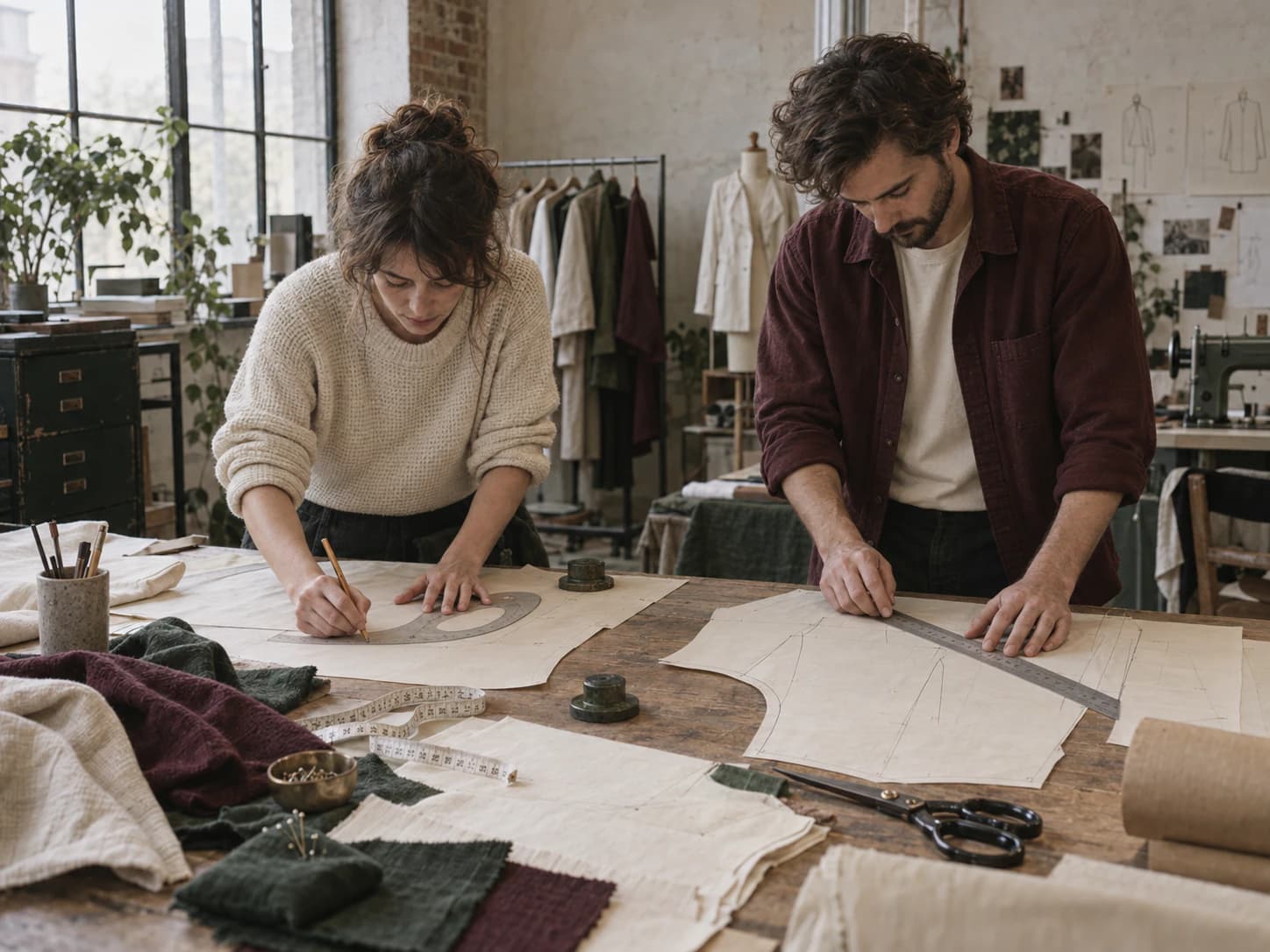
Across a table, clothing appears as a collection of flat shapes. A curved edge and a few pencil marks begin to suggest how something might sit on the body.
A different view of clothing
Daylight spreads across sheets of paper. One hand steadies a ruler while another follows a curve with a pencil. Nearby, a tape measure bends back on itself, and scissors lie beside overlapping pieces of cream, burgundy and green fabric. The table holds several ways of thinking about shape at once.
Seen here, a garment is less immediately familiar. A sleeve laid flat can look surprisingly broad; the curve beneath an arm becomes a clear, deliberate line. Looking from this angle brings attention to areas that are easy to miss when clothes are hanging in a wardrobe.
The space around the body
Proportion lives in the relationship between these parts. A wide sleeve changes how narrow a cuff appears. A longer body gives a pocket a different place in the whole. Even before considering colour, the eye reads the balance between length and width, between an open edge and a closed one.
Then there is the space inside. Clothing can sit near the shoulder and fall away below it, or gather at the wrist after a generous sleeve. These distances help describe a silhouette. To imagine them from paper is to picture a body within the outline.
A shape that keeps changing
Once worn, those outlines meet gravity and movement. An elbow bends and the sleeve forms new folds. Sitting down changes the line across the waist. A hem that looked level on a hanger rises at one side when a hand reaches overhead. The shape is never entirely still.
This is a useful way to look at familiar clothes: follow one line from the shoulder to the cuff, then watch what happens when you move. The pencil drawing offers a beginning. The silhouette continues to take shape in all the ordinary gestures that follow.